Bringing Europe Together

"We believe that it is time to awaken the potential of Central Europe."

Latest

The Iran Conflict and European Energy Security: Two Months In

Russia is the biggest winner, Beijing is the broker. Europe has a small political window opened by Hungary’s election and has yet to build the architecture to use it.

Institute for Central Europe — Mini-Brief | 12 May 2026

On 4 March, the first ICE brief on the Iran conflict identified five risks to European energy security. On 30 March, the one-month follow-up confirmed that all five had materialised. Two months on, the question has changed: the crisis is no longer the chokepoint. It is what the ledger of two months looks like: who profited, who brokered, what got built, and what did not.

When transparency becomes a vulnerability

A new ICE brief by our colleague Miro Sedlák raises a provocative but timely question: has @NATO’s hard‑won predictability become too easy to read? Drawing lessons from recent exercises, the piece shows how standardisation and openness – once stabilising strengths – can now generate operational blind spots. The piece is an important contribution to a growing debate on deterrence, adaptation, and how alliances stay credible in a changing warfighting reality.

Europe’s Defence Industrial Awakening: The Governance Gap Behind the Spending Surge


The EU has built a rulebook for defence-industrial coordination and the first tranche of money to start funding the factories. Whether member states use either at the scale the moment requires is the question this brief leaves open.

The Iran Conflict and European Energy Security: One Month In

The post-Russia energy architecture was never post-geopolitical. It was just geopolitical in a different direction.

Institute for Central Europe — Mini-Brief | 30 March 2026

On 4 March, five days into the US-Israeli strikes on Iran, ICE published an assessment of the conflict’s energy implications for Europe. The brief identified five risks: commercial paralysis of the Strait of Hormuz through insurance repricing and self-deterrence.

District Heating Under Hybrid Attack: Europe’s Municipal Gap and Ukraine’s Resilience Model

Europe secured its gas pipelines and hardened its electricity grids. It left the last mile of heat delivery — the municipal layer that keeps 100 million people warm — virtually undefended.

Institute for Central Europe — Policy Mini Brief | 17 March 2026

ACRONYM analysis: How have European attitudes toward migration evolved over the past decade?

This analysis examines public opinion on migration in France, Germany and the Visegrad countries between 2014 and 2024 using Eurobarometer survey data. It traces how the salience of migration, perceptions of non-EU immigration and support for EU migration governance have changed in response to major political and geopolitical events.

Reflections from ACRONYM Mobilities: Interviews with François Gemenne and Anneliese Depoux

As the ACRONYM project reached its final phase, we spoke with François Gemenne and Anneliese Depoux about their research mobilities in Bratislava and their collaboration with the Institute for Central Europe (ICE). Their reflections highlight how mobility and close collaboration contributed to the project’s comparative research and strengthened interdisciplinary dialogue on migration.

What the Iran War Reveals About Europe’s Air Defence Gap

For years, our institute has warned that air and missile defence is the most acute vulnerability on NATO’s eastern flank, especially for Central Europe and Slovakia. Even before Russia’s full‑scale war, we urged governments to treat this gap not as a distant procurement issue, but as a strategic liability.

From Hormuz to Bratislava: how the Iran conflict reshapes Europe’s energy security

We’re delighted to welcome Miro Sedlák to our  team. He is a defence and security policy researcher with exceptional analytical skills, a strong grasp of modernisation and security trends, and deep familiarity with dual‑use technologies, including AI. He is recognised as a respected voice in the community with publications in international expert outlets, and we’re excited to bring his perspective into our work.

Why Facts Are Not Enough

From Climate Inaction to Democratic Vulnerability: Psychological Barriers in the Age of Climate Disinformation

ICE Perspective

At the Institute for Central Europe, we examine climate governance not only as an environmental challenge, but as a democratic one. Climate disinformation does not operate in a vacuum. It interacts with psychological vulnerabilities, identity dynamics, and trust in institutions. Understanding the behavioral architecture of climate inaction is therefore essential for designing resilient democratic responses. This article contributes to ICE’s growing work at the intersection of environmental governance, public discourse, and democratic resilience.

ACRONYM Policy Paper: Making Cooperation Possible: Narratives, Trust and Moral Frameworks in Europe’s Asylum and Migration Debate

Migration is one of the most polarising issues in Europe – not only because of its scale, but because of the meanings attached to it.

Our new policy paper, Making Cooperation Possible: Narratives, Trust and Moral Frameworks in Europe’s Asylum and Migration Debate, presents the final findings of the ACRONYM project. It argues that cooperation on asylum and migration often fails not due to missing legal instruments, but because it is politically, morally and narratively difficult.

Introducing the ACRONYM Educational Package

We are pleased to introduce the ACRONYM Educational Package, a set of teaching resources designed for upper secondary schools and university courses exploring migration, asylum, and integration. The package combines five ready-to-use classroom activities with an educational video series featuring expert insights on key migration topics.

An Interview with Clarissa Tabosa on Teaching, Cooperation, and the Legacy of ACRONYM

As the ACRONYM project comes to a close, we spoke with Clarissa Tabosa, Rotating Chair in Migration and Asylum Studies and Assistant Professor at the Faculty of Social and Economic Sciences, Comenius University Bratislava. In this interview, she reflects on the moments that defined her experience — from the pedagogical intensity of the ACRONYM Summer Schools to the project’s most significant outcomes and its lasting legacies for research, teaching, and collaboration. She also shares why she believes “connection” best captures the spirit of ACRONYM and its contribution to more nuanced and human-centred conversations on migration.

ACRONYM Team Wrap-Up Meeting in Bratislava

In December 2025, the ACRONYM project team gathered in Bratislava at the Institute for Central Europe (ICE) for its final in-person working meeting of the year. The meeting brought together team members, including representatives of all three project partners – François Gemenne, Anneliese Depoux, and Katarína Cséfalvayová, marking an important moment of reflection and coordination as the project enters its concluding phase.

ICE in the podcast Slovensko a svet očami diplomatov

(Note: The podcast is in Slovak)

Katarína Cséfalvayová was a guest on the podcast Slovensko a svet očami diplomatov (Slovakia and the World Through the Eyes of Diplomats), hosted by Martin Klus and produced by Hospodárske noviny. In the interview, she explains why the international environment has changed more profoundly in recent years than during the entire period since 1989, what this means for Slovakia, and what Europe can do to become better prepared and more resilient.

ACRONYM Organises Paris Policy Dialogue on Migration: Key Insights and Outcomes

Paris, 8. December 2025

On 8 December 2025, the ACRONYM project organised a closed-door Policy Dialogue on Migration at the Conférence des Évêques de France (CEF) in Paris. The dialogue brought together clergy, theologians, researchers, migration experts, and representatives of Church institutions to reflect on the relationship between Christian teaching, pastoral practice, and contemporary migration debates in Europe.

How Dual-Use Technologies Can Turn Europe’s Potential into Power


 The new Atomico State of European Tech report has just been released, and it offers a picture of Europe that is far more complex and far more hopeful than the usual conversation suggests. Europe now employs around 4.6 million people in tech, a workforce that has been growing faster than the American one for several years. It also produces more STEM graduates than the United States, which gives the continent a depth of technical and engineering talent that many countries would envy. Close to a third of all new global founders now emerge from Europe, and deep tech has become one of the continent’s strongest areas of investment. These are not small achievements. They reflect a continent that has the intellectual and scientific capacity to define the next technological decade.

ICE at the Opening Panel of WARM Paris 2025

Bringing the CEE Perspective to Europe’s Climate and Geopolitical Debate

On 5 November 2025, ICE Director Katarína Cséfalvayová spoke at the opening panel of the inaugural WARM Paris conference, hosted by 2050NOW and Les Echos Le Parisien. The event brought together leaders from business, finance, and policymaking to discuss how Europe can remain resilient amid rising geopolitical tensions while accelerating the green transition.

ACRONYM Final Conference in Paris

Looking back at ACRONYM Final Conference in Paris

On November 4–5, the ACRONYM Project held its final conference in Paris, bringing together around fifty participants at the Learning Planet Institute during the two-day programme, and more than 180 guests for the evening event at the National Museum of the History of Immigration. The gathering offered an interdisciplinary space connecting research, art, and practice, and explored how migration is represented, communicated, and governed across diverse contexts.

The first joint ICE and Pleronix analysis explores a realistic air-defense strategy for Europe


The first joint publication resulting from the new cooperation between the Institute for Central Europe (ICE) and Pleronix is the analysis “Affordable Sovereignty: A Realistic Air-Defense and Counter-Drone Strategy for Europe’s Small and Mid-Size Nations.”
It examines realistic options for European countries in air-defense and counter-drone capabilities — while emphasizing the growing importance of threat assessment as a cornerstone of modern security strategy.

ICE Announces Strategic Cooperation with Global Analytics Leader Pleronix


We are pleased to announce the beginning of our cooperation with Pleronix, an internationally recognized analytical company specializing in monitoring and evaluating trends across key areas of social, economic, and technological development. Pleronix’s expertise extends to defense and security, international relations, and the activities of state and non-state actors shaping the global landscape.

From Laggards to Leaders: Green Innovation and CEE’s Climate Opportunity

New ICE Policy Brief | October 2025


As Europe accelerates its push toward climate neutrality, Central and Eastern European (CEE) countries are often portrayed as lagging behind:less innovative, more emission intensive, and politically cautious. A new policy brief from the Institute for Central Europe challenges this narrative, arguing that it overlooks both the region’s potential and its strategic importance.

Events

ICE in the podcast Slovensko a svet očami diplomatov

Bratislava, december 2025 (Note: The podcast is in Slovak) Katarína Cséfalvayová was a guest on the podcast Slovensko a svet očami diplomatov (Slovakia and the World Through the Eyes of Diplomats), hosted by Martin Klus and produced by Hospodárske noviny. In the interview, she explains why the international environment has changed more profoundly in recent years than during […]

ICE at the Opening Panel of WARM Paris 2025

Bringing the CEE Perspective to Europe’s Climate and Geopolitical Debate On 5 November 2025, ICE Director Katarína Cséfalvayová spoke at the opening panel of the inaugural WARM Paris conference, hosted by 2050NOW and Les Echos Le Parisien. The event brought together leaders from business, finance, and policymaking to discuss how Europe can remain resilient amid […]

ACRONYM Final Conference in Paris

Paris, November 4.-5. 2025 Looking back at ACRONYM Final Conference in Paris On November 4–5, the ACRONYM Project held its final conference in Paris, bringing together around fifty participants at the Learning Planet Institute during the two-day programme, and more than 180 guests for the evening event at the National Museum of the History of […]

Beyond Borders: Representations, Perceptions and Lines of Passage, ACRONYM Summer School 2025 at Corsica

From 6 to 11 July 2025, the STARESO Research Station in Calvi, Corsica, hosted the third edition of the ACRONYM project’s interdisciplinary summer school titled Beyond Borders: Representations, Perceptions and Lines of Passage. This enriching ACRONYM project event brought together leading scholars, experts, and students to engage deeply for in-depth discussions on migration, asylum, borders, […]

Projects

ICE Conference on Unmanned Aerial Systems for the Slovak Armed Forces

Košice, December 3, 2024 The Institute for Central Europe, in collaboration with the Ministry of Defense of the Slovak Republic and the Faculty of Aeronautics at the Technical University of Košice, hosted a conference on December 3, titled „Enhancing Slovak Armed Forces through Unmanned Aerial Systems (UAS): Needs and Insights.“ The conference commenced with speeches […]

ACRONYM – Advancing Cooperation on Asylum and Migration

1.1.2023 – 31.12.2025 The project, funded under the Horizon Europe scheme, aims to strengthen cooperation between ICE, the University of Liège, and the University of Paris on the topic of migration and asylum. The project reflects on the deep divisions that have emerged between EU countries as a result of the 2015-16 migration crisis. The […]

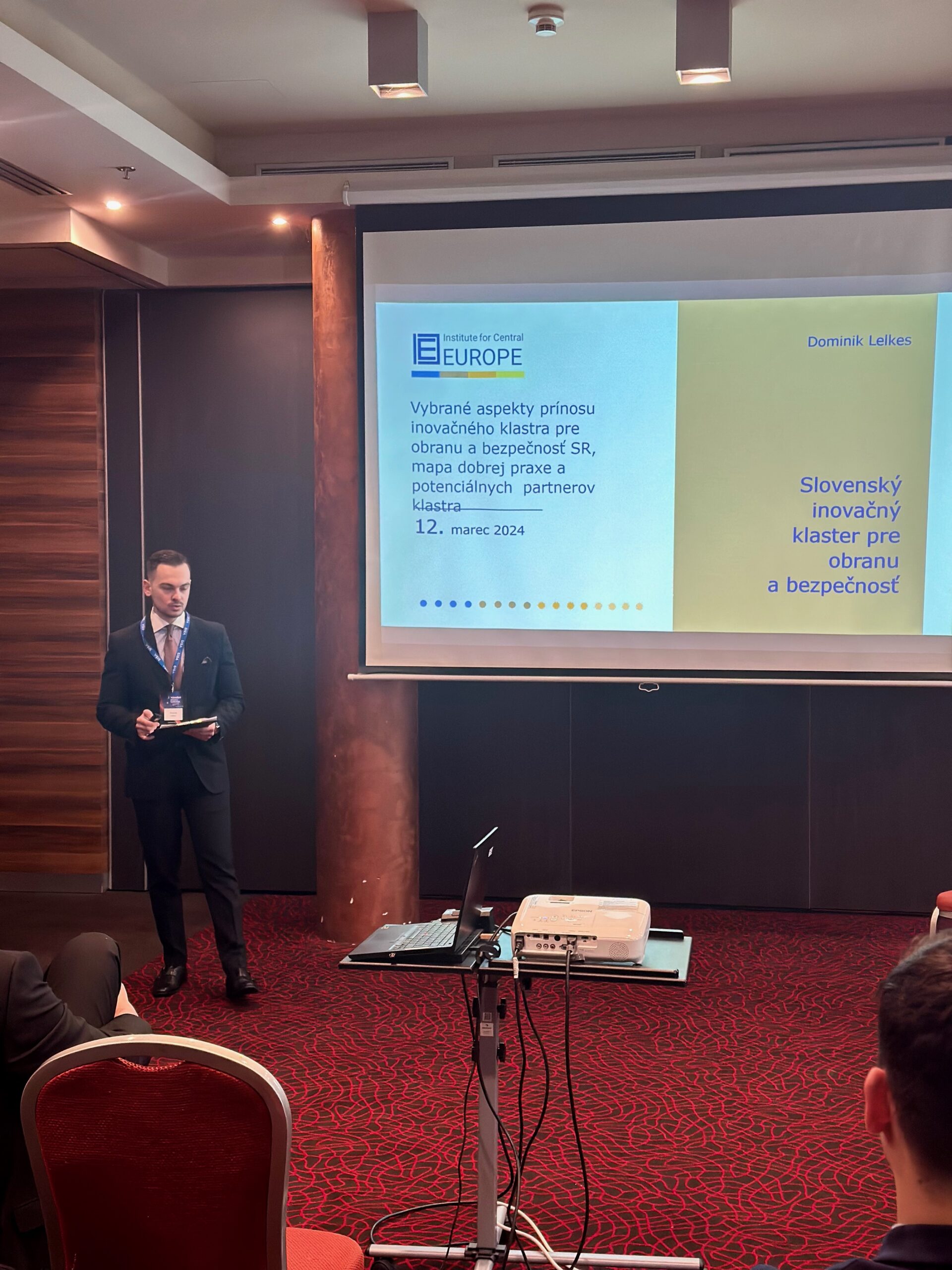
Slovak Innovation Centre for Defence and Security Technologies

2.2.2023 – 30.11.2023     International cooperation is a prerequisite for technological development and provides external know-how that can be used to strengthen and improve a country’s innovation capacity. ICE recognises the added value of such a collaborative approach. As part of its project “Slovak Innovation Cluster for Defence and Security”, which aims to map […]

ACCESS – Addressing the Challenges of Climate, Defence and Security Nexus

15.4.2022 – 31.12.2022     The project focused on the security and defence impacts of climate change with the aim to open a public debate in the Slovak Republic and the Central European region on these topics, as well as to raise awareness of the issue and to highlight the efforts of the North Atlantic […]

Publications

The Iran Conflict and European Energy Security: Two Months In

Russia is the biggest winner, Beijing is the broker. Europe has a small political window opened by Hungary’s election and has yet to build the architecture to use it. Institute for Central Europe — Mini-Brief | 12 May 2026 On 4 March, the first ICE brief on the Iran conflict identified five risks to European […]

When transparency becomes a vulnerability

A new ICE brief by our colleague Miro Sedlák raises a provocative but timely question: has @NATO’s hard‑won predictability become too easy to read? Drawing lessons from recent exercises, the piece shows how standardisation and openness – once stabilising strengths – can now generate operational blind spots. The piece is an important contribution to a growing […]

Europe’s Defence Industrial Awakening: The Governance Gap Behind the Spending Surge

The EU has built a rulebook for defence-industrial coordination and the first tranche of money to start funding the factories. Whether member states use either at the scale the moment requires is the question this brief leaves open. Institute for Central Europe — Policy Mini Brief | April 2026   Executive Summary On 30 March […]

The Iran Conflict and European Energy Security: One Month In

The post-Russia energy architecture was never post-geopolitical. It was just geopolitical in a different direction. Institute for Central Europe — Mini-Brief | 30 March 2026 On 4 March, five days into the US-Israeli strikes on Iran, ICE published an assessment of the conflict’s energy implications for Europe. The brief identified five risks: commercial paralysis of […]

Partners